The Quran vs Bible comparison is one of the most searched topics for anyone interested in religious studies, interfaith dialogue, or understanding the core teachings of Islam and Christianity. Both are sacred scriptures of two major world religions, and while they share some common themes, they also have significant differences in structure, authorship, preservation, and teachings.
In this article, we will provide a clear, factual, and neutral guide to help you understand both scriptures. Whether you are a student, a curious reader, or someone exploring interfaith perspectives, this post addresses the questions and concerns that most people have, including:
- Key differences in authorship, revelation, and preservation
- Similarities in moral teachings, stories of prophets, and core values
- Frequently asked questions such as how Jesus is described in each scripture, the historical order of revelation, and whether the Quran confirms the Bible
If you’re new to the Quran, you may find our guide What Is the Quran? Meaning, Purpose, and Teachings in Islam helpful for understanding its significance before diving into detailed comparisons. All information in this article is based on authenticated scripture and scholarly interpretations to ensure accuracy and reliability.
By the end of this post, you will have a clear understanding of the similarities, differences, and unique aspects of both the Quran and the Bible, helping you make informed observations and engage in meaningful discussions.
What is the Quran?

The Quran is the holy book of Islam, believed to be the literal word of God revealed to Prophet Muhammad ﷺ over a period of 23 years. Written in classical Arabic, it serves as a complete guide for life, offering guidance on moral, social, spiritual, and legal matters. Understanding the Quran is essential, especially when exploring topics like Quran vs Bible, as it provides context on its structure, preservation, and teachings.
The Quran is divided into 114 chapters called Surahs, which are further subdivided into over 6,236 verses (Ayahs). Every verse was carefully memorized by the Prophet’s companions and documented in writing, ensuring its accuracy and authenticity — a key reason why the Quran has remained unchanged for over 1,400 years.
For beginners, learning to read the Quran correctly is crucial. You can start with guides like Learn to Read Quran Step-by-Step (Complete Beginner’s Guide) or Why Learn Noorani Qaida Before Reading the Quran.
Key Points About the Quran:
- Total Chapters: 114 Surahs, covering topics from worship, ethics, social guidance, family laws, and spirituality. Each Surah addresses different aspects of life, helping followers navigate moral and social challenges.
- Total Verses: ~6,236 Ayahs, each conveying lessons on morality, faith, justice, human behavior, and guidance for everyday life.
- Language: Classical Arabic, preserving the original phrasing of revelation, which is essential for maintaining the Quran’s authenticity and poetic structure.
- Preservation: Memorized and written down by Prophet Muhammad ﷺ’s companions, ensuring the text remains unchanged for over 1,400 years. The meticulous preservation allows Muslims today to read the exact words as revealed.
- Purpose: Serves as a complete guide for spiritual, ethical, social, and legal matters, offering instructions on worship, relationships, societal responsibilities, and personal development.
- Relevance for Quran vs Bible Comparison: Understanding the Quran’s structure, purpose, and preservation helps readers see how it differs from or aligns with other scriptures, including the Bible.
- Practical Guidance: Offers principles for daily life, such as honesty, compassion, charity, patience, and justice, making it applicable beyond religious rituals.
- Learning Path: Beginners are encouraged to start with foundational resources like Noorani Qaida PDF or structured guides to build a strong understanding of Quranic reading.
- Scholarly Verification: Scholars agree on the Quran’s authenticity and unchanged preservation, reinforcing its credibility and authority in religious studies and interfaith comparisons.
For a detailed explanation of its structure, see How is the Quran Organized? Structure and Divisions.
What is the Bible?
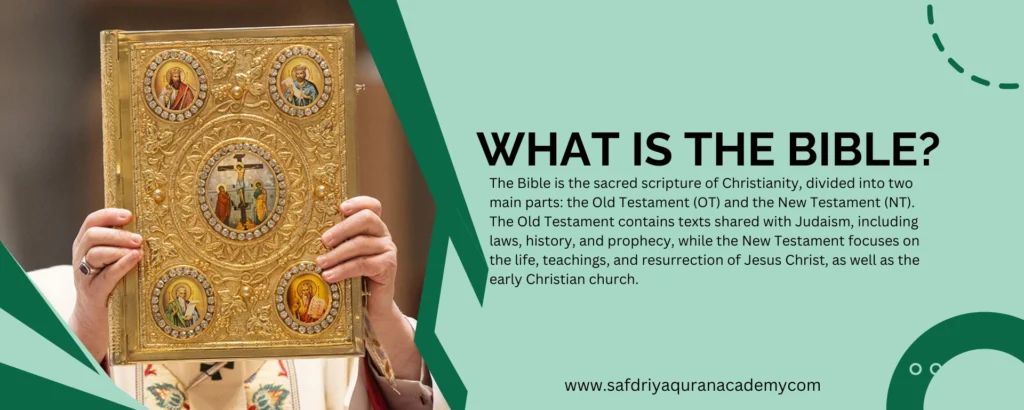
The Bible is the sacred scripture of Christianity, divided into two main parts: the Old Testament (OT) and the New Testament (NT). The Old Testament contains texts shared with Judaism, including laws, history, and prophecy, while the New Testament focuses on the life, teachings, and resurrection of Jesus Christ, as well as the early Christian church. For more detailed historical and theological context, see Britannica – Bible.
Unlike the Quran, the Bible was written over several centuries by multiple authors in Hebrew, Aramaic, and Greek. Its preservation relies on various manuscripts and translations, which can lead to minor textual variations. Understanding this is essential when exploring Quran vs Bible, as the differences in authorship, structure, and preservation shape each book’s teachings and interpretation. For scholarly perspectives on its composition and history, refer to Oxford Biblical Studies Online.
Key Points About the Bible:
- Total Books: 66 (39 OT + 27 NT), covering laws, prophecy, history, wisdom, and teachings of Jesus
- Total Verses: ~31,000, conveying moral guidance, spiritual lessons, and narratives about humanity’s relationship with God
- Languages: Hebrew, Aramaic, Greek, reflecting its compilation over centuries and diverse historical contexts
- Compilation: Written by multiple authors across different eras, with variations in style, perspective, and audience
- Purpose: Provides spiritual guidance, ethical principles, and the foundation of Christian faith, shaping worship, moral conduct, and daily life
- Themes: Focuses on monotheism, morality, justice, compassion, and the life and mission of Jesus Christ
- Relevance for Quran vs Bible Comparison: Understanding the Bible’s structure, authorship, and teachings is crucial for meaningful comparison with the Quran
- Practical Insight: Readers often want clarity on how the Bible portrays Jesus, what guidance it provides for life, and how its preservation differs from the Quran
- Scholarly Verification: Historical and theological studies confirm the Bible’s composition and compilation process, supporting its credibility for academic and religious inquiry. For a detailed study of textual history, see Yale Divinity School – Biblical Manuscripts.
The Bible addresses many of the same fundamental themes as the Quran, such as monotheism, moral guidance, and stories of prophets, but differs in authorship, language, and compilation. By understanding these differences, readers can better appreciate the unique characteristics of both scriptures in the Quran vs Bible discussion.
Quran vs Bible – Key Differences
Comparing the Quran vs Bible involves examining their revelation, authorship, language, preservation, and structure. Understanding these differences helps clarify common questions, address misconceptions, and provide a solid foundation for interfaith learning.
Comparison Table: Quran vs Bible
| Feature | Quran | Bible |
|---|---|---|
Revelation |
Word of God revealed to Prophet Muhammad ﷺ over 23 years |
Written by multiple authors over centuries (Britannica – Bible) |
Authorship |
Single messenger: Prophet Muhammad ﷺ |
Multiple prophets, historians, apostles (Oxford Biblical Studies) |
Language |
Classical Arabic |
Hebrew, Aramaic, Greek |
Compilation & Preservation |
Memorized and written during Prophet’s life, ensuring exact preservation (Al-Islam.org – Quran Preservation) |
Manuscripts collected over centuries, leading to textual variations and multiple translations (Yale Divinity School – Biblical Manuscripts) |
Key Context and Insights
- Revelation:
The Quran was revealed gradually over 23 years, allowing Prophet Muhammad ﷺ and his companions to verify and memorize each verse, ensuring authenticity. In contrast, the Bible was written over centuries by multiple authors, which means textual variations can appear across manuscripts and translations. - Authorship:
The Quran was delivered by a single messenger, while the Bible reflects the work of numerous prophets, historians, and apostles, offering diverse perspectives. This difference influences the unity of message and literary style in each scripture. - Language:
The Quran’s classical Arabic preserves its original meaning and poetic structure, while the Bible’s multiple languages reflect historical and cultural diversity, affecting interpretation across different translations. - Compilation & Preservation:
Quranic verses were memorized and written down during the Prophet’s lifetime, making it one of the most meticulously preserved religious texts in history. The Bible’s manuscripts were collected and compiled over centuries, which is why scholars carefully study textual history to understand differences between translations and versions.
Understanding these differences is essential for anyone exploring Quran vs Bible, whether for academic study, personal learning, or interfaith dialogue. Recognizing how each scripture was revealed, preserved, and structured helps clarify common misconceptions and strengthens informed discussion.
Preservation and Accuracy: Quran vs Bible
Comparison Table: Preservation and Accuracy
Feature | Quran | Bible |
Preservation | Carefully preserved through memorization and written records by Prophet Muhammad ﷺ and his companions, remaining unchanged for over 1,400 years (Al-Islam.org – Quran Preservation) | Compiled from multiple manuscripts and translations over centuries, leading to slight textual variations (Yale Divinity School – Biblical Manuscripts) |
Accuracy | Considered fully authentic in wording and meaning by Islamic scholarship | Scholars recognize historical accuracy but acknowledge minor differences among translations and copies |
Religious Confirmation | The Quran references and confirms the earlier scriptures in some passages (Does the Quran confirm the Bible?) | No direct claim of confirming the Quran; interpretations vary across denominations |
Key Insights
- Quran Preservation:The Quran was revealed gradually over 23 years and memorized by thousands of companions, while also being written down during the Prophet’s lifetime. This dual oral and written transmission ensures the text remains unchanged, addressing concerns like “Does the Quran say the Bible is corrupted?” Islamic scholarship clarifies that the Quran acknowledges the previous scriptures but notes human alterations over time.
- Bible Preservation:The Bible was written over centuries in multiple languages and compiled from diverse manuscripts. While it is historically reliable and provides consistent moral and spiritual teachings, variations exist between translations and copies, which is a key difference from the Quran’s meticulous preservation.
- Why It Matters for Quran vs Bible Comparisons:Understanding preservation highlights the authenticity, textual reliability, and authority of each scripture. Readers exploring interfaith topics or textual studies can better appreciate how each book has been maintained over time.
Structure and Length: Quran vs Bible
When comparing the Quran vs Bible, understanding their structure, length, and organization is essential for readers who want clarity on how each scripture presents its teachings. These differences impact reading, interpretation, and study approaches.
Comparison Table: Structure and Length
Feature | Quran | Bible |
Total Chapters / Books | 114 Surahs | 66 Books (39 OT + 27 NT) |
Total Verses | ~6,236 Ayahs | ~31,000 Verses |
Length Comparison | Shorter but concise, with clear guidance in every verse | Longer with detailed narratives, parables, and historical accounts |
Organization | Thematic and chronological; topics often repeated for emphasis | Historical and narrative-based; sequences reflect multiple authors and eras |
Key Insights
- Quran Structure:
The Quran’s 114 Surahs are arranged roughly from longest to shortest rather than strictly chronologically. Its thematic repetition reinforces moral, spiritual, and legal teachings, making it concise yet impactful for readers. - Bible Structure:
The Bible’s 66 books are compiled over centuries and arranged into the Old and New Testaments, containing historical narratives, poetry, laws, and teachings of prophets. Its length allows for detailed storytelling, but the variety of authors and time periods can make it more complex to navigate. - Reading Considerations:
The Quran is shorter in length but dense with guidance, whereas the Bible provides expansive narratives covering the history, teachings, and laws of the Israelites and early Christians. For readers curious about reading time, see our guide How Long Does It Take to Read the Quran? A Complete Guide. - Why It Matters for Quran vs Bible Comparisons:
Understanding structure and length helps readers approach study and comprehension effectively, whether learning for personal knowledge, interfaith dialogue, or academic purposes.
Teachings and Messages: Quran vs Bible
Both the Quran and Bible share core teachings, yet they present them differently based on religious context, purpose, and audience. Understanding these teachings helps readers explore moral guidance, spiritual principles, and the portrayal of key figures such as Jesus.
Core Teachings and Messages
Monotheism:
- Quran: Emphasizes strict monotheism; God (Allah) is singular and unique (Al-Islam.org – Concept of God)
- Bible: Emphasizes one God; Christianity teaches the Trinity—Father, Son, and Holy Spirit (Britannica – God in Christianity)
- Quran: Emphasizes strict monotheism; God (Allah) is singular and unique (Al-Islam.org – Concept of God)
Ethical Living & Moral Guidance:
- Quran: Provides clear guidance for daily life, including honesty, charity, patience, and justice
- Bible: Offers moral lessons through commandments, parables, and examples, emphasizing compassion, honesty, and righteousness
- Quran: Provides clear guidance for daily life, including honesty, charity, patience, and justice
Stories of Prophets:
- Quran: Includes Adam, Noah, Moses, Jesus (Isa), and other prophets; stories focus on universal moral and spiritual lessons
- Bible: Includes Adam, Noah, Moses, Jesus, and others; stories provide historical, spiritual, and moral teachings
- Quran: Includes Adam, Noah, Moses, Jesus (Isa), and other prophets; stories focus on universal moral and spiritual lessons
About Jesus:
- Quran: Jesus (Isa) is a prophet, not divine, and respected as a messenger of God
- Bible: Central figure in the New Testament; considered the Son of God and savior (Britannica – Jesus Christ)
- Quran: Jesus (Isa) is a prophet, not divine, and respected as a messenger of God
Key Insights
- The Quran and Bible both emphasize belief in one God, but the concept of God differs between Islam and Christianity.
- Ethical guidance is provided in both scriptures, but the Quran often gives direct instructions, whereas the Bible uses stories and parables to convey lessons.
- Stories of prophets serve as moral and spiritual lessons, but the Quran focuses on universal guidance, while the Bible emphasizes historical and narrative context.
- Understanding Jesus’ role in both scriptures helps address common questions in the Quran vs Bible comparison, clarifying the differences in religious beliefs.
Similarities Between Quran and Bible
While the Quran vs Bible comparison often focuses on differences, it’s equally important to understand the key similarities that unite these scriptures. Both books offer moral guidance, spiritual lessons, and stories of prophets that shape the faith and practice of their followers.
Shared Teachings and Themes
- Ethical and Moral Teachings:
Both scriptures emphasize honesty, justice, compassion, and ethical living as a core part of faith. These principles guide personal conduct and social responsibility. - Stories of Key Prophets:
Figures such as Adam, Noah, Moses, and Jesus appear in both books, providing examples of devotion, obedience, and perseverance in the face of trials. These stories often teach universal moral lessons and spiritual reflection (Al-Islam.org – Prophets in the Quran) (Britannica – Prophets in the Bible). - Emphasis on Worship, Charity, and Compassion:
Both texts encourage believers to maintain regular worship, help the needy, and practice compassion toward others as a reflection of faith. - Calls for Monotheism and Obedience to God:
Both the Quran and Bible affirm the existence of a single, supreme God and instruct followers to live in accordance with divine guidance.
Key Insights
- Despite differences in structure, authorship, and language, the Quran and Bible converge on core moral and spiritual values.
- Understanding these similarities helps readers build bridges in interfaith dialogue, promotes comparative religious literacy, and reduces misconceptions.
- Recognizing shared teachings also clarifies common ground for believers and scholars, which is a key aspect of the Quran vs Bible similarities discussion.
Quran vs Bible – Key Takeaways
Understanding the Quran vs Bible comparison helps readers clarify differences, recognize similarities, and approach interfaith learning with informed insights. Here’s a concise summary of the most important points:
Authorship & Revelation
- Quran: Revealed over 23 years to Prophet Muhammad ﷺ as the final message of God, preserved both orally and in writing (Al-Islam.org – Quran Preservation).
- Bible: Written over centuries by multiple authors in Hebrew, Aramaic, and Greek. Textual variations exist across manuscripts and translations (Yale Divinity School – Biblical Manuscripts).
Structure & Length
- Quran: 114 chapters (Surahs) with ~6,236 verses (Ayahs); concise and thematic.
- Bible: 66 books (39 Old Testament + 27 New Testament) with ~31,000 verses; longer, narrative-driven, and compiled from diverse sources.
- Internal Resource: For reading time and structure, see How Long Does It Take to Read the Quran? A Complete Guide.
Teachings & Messages
- Both emphasize monotheism, ethical living, and moral guidance.
- Prophets in both: Adam, Noah, Moses, and Jesus.
- Quran: Jesus (Isa) is a prophet and messenger.
- Bible: Jesus is divine and central to salvation (Britannica – Jesus Christ).
- Internal Resource: Learn foundational Quran teachings with What Is the Quran? Meaning, Purpose, and Teachings in Islam.
Preservation & Authenticity
- Quran: Meticulously preserved; text remains unchanged over centuries.
- Bible: Translated and copied multiple times, leading to minor textual variations.
Key Similarities
- Stories of prophets and moral lessons are present in both scriptures.
- Both emphasize compassion, justice, worship, and guidance on living a righteous life.
Key Differences
- Quran: Concise, in one language, addressing primarily Muslim audiences.
- Bible: Extensive narratives spanning multiple cultures, languages, and historical eras; diverse literary styles.
Why Understanding Matters
- Clarifies misconceptions between religions.
- Supports interfaith dialogue, academic study, and personal learning.
- Helps readers appreciate the unique role and message of each scripture.
Practical Tip for Learners
- Beginners can benefit from structured resources:
Why Understanding Quran vs Bible Matters
Learning the differences and similarities between the Quran and Bible promotes respectful interfaith understanding, informed study, and personal knowledge. Whether for academic research, spiritual growth, or curiosity, understanding these scriptures helps clarify misconceptions, appreciate shared moral teachings, and engage in meaningful dialogue. For readers looking to explore the Quran further, resources like What Is the Quran? Meaning, Purpose, and Teachings in Islam and Learn to Read Quran Step-by-Step (Complete Beginner’s Guide) provide helpful guidance.
Frequently Asked Questions
Have questions about Quran vs Bible
No. While both are holy scriptures, the Quran is specific to Islam and the Bible to Christianity. Their origins, authorship, and structure differ significantly.
The Bible was written over centuries before the Quran, which was revealed to Prophet Muhammad ﷺ in the 7th century.
The Quran acknowledges some of the Bible’s content but also mentions that portions of earlier scriptures have been altered.
Muslims respect the Bible as a revealed text but follow the Quran as the final and complete revelation.
Yes, Jesus (Isa) is a prophet and messenger in the Quran.
The Quran has a single author (Prophet Muhammad ﷺ), is in Arabic, and was preserved orally and in writing. The Bible has multiple authors and languages.
The Quran has ~6,236 verses, while the Bible contains ~31,000 verses across 66 books.
Jesus is described as a prophet who performed miracles, was born of the Virgin Mary, and preached monotheism.
Islam acknowledges the Torah (Old Testament) as a divine revelation, but believes the Quran is the final and complete message.
Yes, most books of the Bible were written centuries before the Quran’s revelation.


